
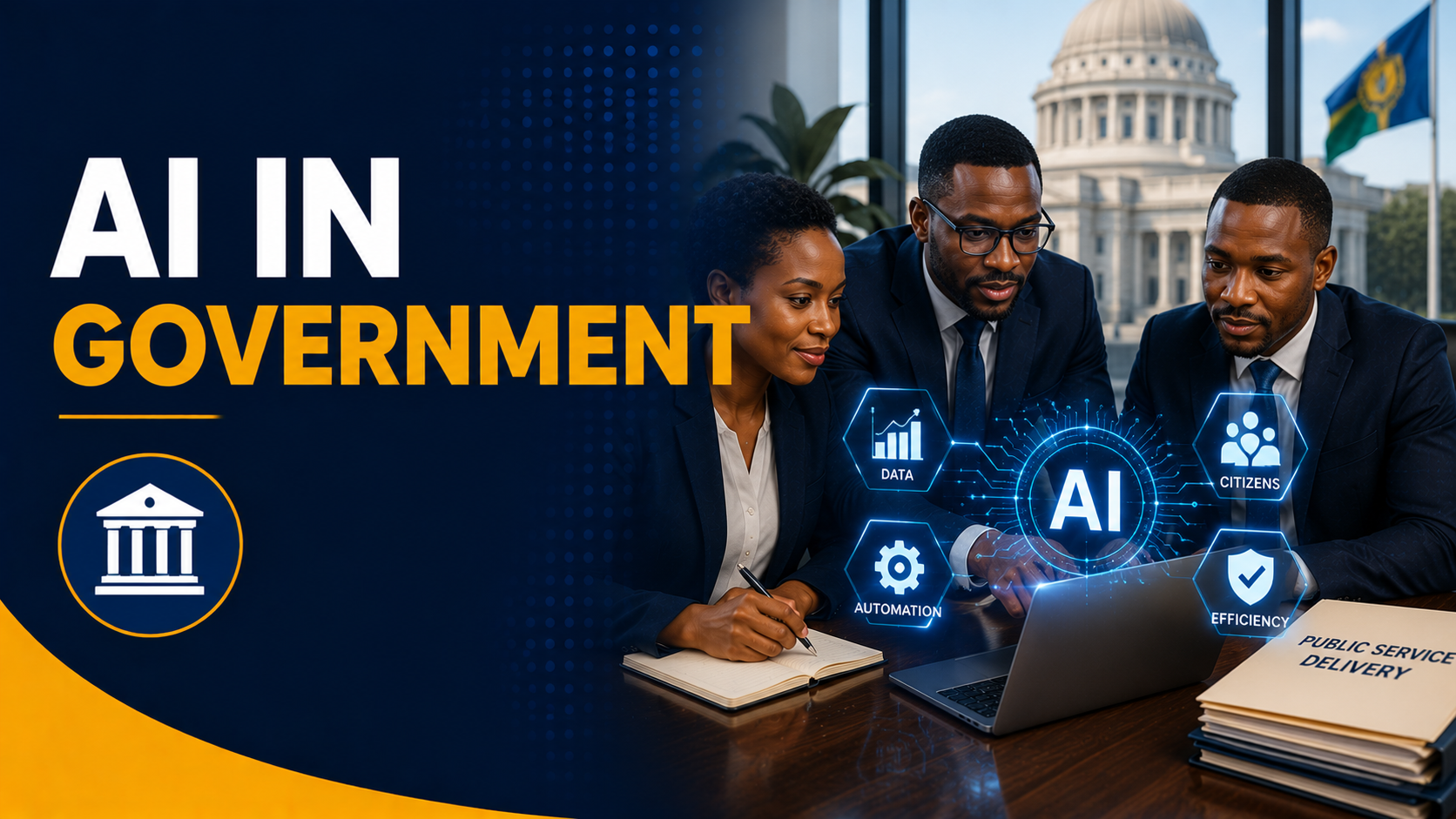
Government agencies across Africa are under enormous pressure to do more with less. Citizens expect faster services, greater transparency, and more effective use of public resources. AI does not have to mean a multi-year, multi-million-dollar digital transformation programme. There are practical, low-risk, high-impact ways for government agencies to start benefiting from AI today.
Three Low-Risk Entry Points
1. AI-Assisted Document Processing and Summarisation
Government agencies generate and receive enormous volumes of documents — reports, correspondence, policy submissions, audit findings. Modern AI tools (including Microsoft Copilot, which integrates with existing Microsoft 365 environments) can summarise lengthy documents in seconds, extract key action items, and identify relevant precedents. The official still makes the decision — but they make it with a comprehensive summary rather than having to read 200 pages.
Risk level: Very low. The AI is assisting with reading and summarising, not making decisions. Data stays within the organisation's existing environment.
2. Citizen Query Management and Triage
Most government agencies receive high volumes of similar citizen queries. AI-powered chatbots can handle routine queries automatically, freeing human staff for complex cases. These systems can be implemented on the agency's website or WhatsApp channel — already widely used in Africa for citizen communication — without replacing any existing systems.
Risk level: Low to medium. Implement with clear escalation pathways to human agents for complex queries. Regularly audit responses for accuracy.
3. Data Analytics for Performance Reporting
AI-powered analytics tools can connect to existing data sources, generate visualisations, identify notable trends, and even draft narrative summaries for mandatory reports. This is perhaps the lowest-risk AI application available — the AI is working on data the agency already holds, for purposes it is already required to fulfil.
"The best way to start with AI in government is to find the tasks that are most repetitive, most time-consuming, and least dependent on human judgment — and automate those first." — Paul Mesike
Implementation Principles for Government AI
- Human oversight remains paramount. AI tools in government should always have human review points built into the process.
- Transparency with citizens. Where AI is involved in processes that affect citizens, communicate this clearly.
- Build skills alongside technology. Invest in training your staff to work effectively with AI tools.
Government agencies that begin building AI literacy and capability now will be far better positioned for the larger digital transformation programmes that are inevitable in the coming years. The goal in 2026 is not to transform overnight — it is to start learning, start building capability, and start delivering small, visible wins.
Ready to Build This Skill?
INTCCARD offers executive training in AI & Technology and 22 other disciplines — delivered in Mbabane, across Africa, and virtually.
Apply for Artificial Intelligence for Decision Support →